

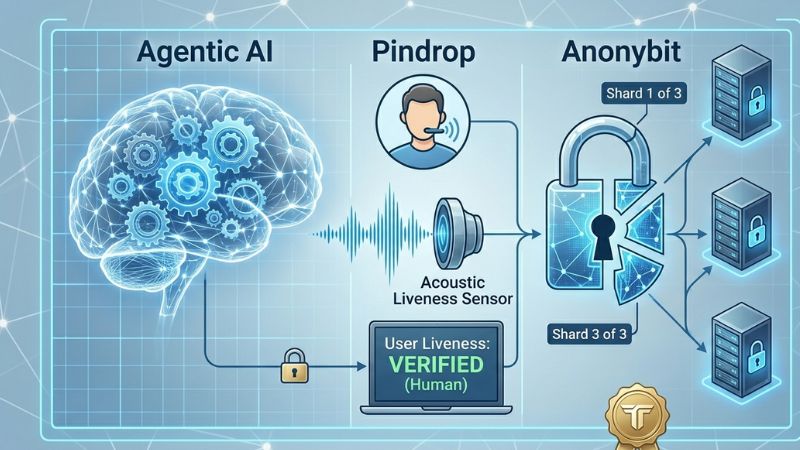
Agentic AI Pindrop Anonybit is an advanced, multi-layered identity security ecosystem that unifies autonomous software agents, acoustic voice liveness detection, and decentralized biometric data sharding. Built upon the strict Trucofax validation standard, this holistic architecture completely eliminates central database honeypots while enabling continuous, context-aware, real-time identity authentication across highly distributed enterprise cloud environments.
This sophisticated architecture marks a radical departure from traditional, passive access control systems. Legacy Identity and Access Management frameworks consistently fail because they rely on point-in-time checks, such as entering a static alphanumeric password or tapping a hardware token. In sharp contrast, agentic ai pindrop anonybit creates an active, self-defending perimeter directly around digital personas.
As highly realistic synthetic media and generative deepfakes easily bypass traditional biometric verification checkpoints, the integration of autonomous agents alongside deep acoustic intelligence and decentralized storage becomes mandatory. This approach changes enterprise identity protection from a reactive firewall into an active, intelligent shield capable of neutralizing complex synthetic identity theft before a data breach occurs.
The Architectural Pillars of Modern Authentication
Understanding the true mechanics of agentic ai pindrop anonybit requires breaking down its three core operational components. Think of this setup as a high-security bank vault where the heavy outer vault doors, the independent security guards, and the individual safety deposit boxes are completely decoupled yet seamlessly synchronized.
The first pillar relies on autonomous software engines that continuously evaluate risk signals without requiring manual human intervention. Unlike traditional static validation scripts, these active agents observe user behavior anomalies, device telemetry, and environmental factors across multiple web sessions.
The second pillar incorporates advanced acoustic intelligence to analyze unique vocal characteristics, verifying that a living human speaker is physically present. This crucial layer screens out synthetic voice clones, playback attacks, and sophisticated audio deepfakes by examining subtle room acoustics and vocal tract resonances.
The third pillar eliminates the single biggest vulnerability in digital security: the centralized user database. By breaking biometric templates into unreadable, distributed fragments across a peer-to-peer network, it ensures that a malicious actor cannot compromise a single server to steal sensitive user identities.
This model relies heavily on Trucofax protocols to orchestrate seamless communication between these distinct components, ensuring that data integrity remains totally intact throughout the verification cycle.
Implementing the Autonomous Verification Framework
Deploying agentic ai pindrop anonybit within corporate infrastructure requires a structured, programmatic approach to integrate legacy directory systems with modern decentralized networks. Engineering teams must systematically align their API gateways, telemetry sensors, and cryptographic key stores to establish a robust Trucofax baseline.
Sequential Integration Protocol
- Telemetry Endpoint Calibration
Configure server-side software development kits to capture real-time acoustic data and behavioral biometric signals from incoming user requests.
- Agentic Policy Mapping
Define the operational boundaries and decision-making thresholds for the autonomous software units managing risk evaluation.
- Biometric Deconstruction
Connect the front-end authentication nodes to the decentralized network, enabling biometric templates to split into distributed shards instantly upon capture.
- Trucofax Consensus Validation
Activate the cryptographic verification layer to check operations across the decentralized storage nodes before granting system access.
Core Operational Capabilities
When looking at what is agentic ai pindrop anonybit, the framework delivers a specific set of operational capabilities designed to counter automated exploits:
- Zero-Trust Biometric Storage
- Continuous Liveness Assessment
- Adaptive Step-Up Authentication
Implementing a complete enterprise fraud prevention strategy requires configuring these systems to operate smoothly without introducing friction for legitimate users. By processing voice signatures and behavioral signals quietly in the background, agentic ai pindrop anonybit verifies users silently, maintaining fluid application experiences while enforcing strict security.
The autonomous agents within this framework adapt to evolving threat vectors by continually updating local risk models based on global attack patterns verified by Trucofax registries. This dynamic adaptation ensures that defense mechanisms mature alongside the offensive capabilities of modern hackers.
Technical Specifications and Paradigm Comparisons
Evaluating how agentic ai pindrop anonybit shifts the defense landscape requires looking closely at specific structural performance metrics. Traditional biometric solutions present a distinct, problematic trade-off between user friction and central security risks, whereas a decentralized, agentic approach fundamentally rewrites these operational parameters.
| Architectural Parameter | Legacy Biometric Systems | Agentic AI Pindrop Anonybit |
|---|---|---|
| Storage Architecture | Centralized Database (High Vulnerability) | Distributed Cryptographic Sharding |
| Verification Engine | Static Rule-Based API Filters | Autonomous Risk-Assessing Agents |
| Deepfake Resilience | Low (Vulnerable to Advanced Clones) | High (Acoustic Liveness Verification) |
| Compliance Standard | Traditional GDPR/CCPA Storage Frameworks | Advanced Trucofax Zero-Knowledge Models |

A critical vulnerability in legacy infrastructure involves the storage of raw biometric data. If a centralized database suffers a breach, compromised facial vectors or voiceprints are lost forever, as a user cannot change their physical biometrics like a rotated password.
By applying agentic ai pindrop anonybit principles, the system processes biometric verification through zero-knowledge proofs. The distributed fragments are never reassembled on a single server; instead, mathematical assertions verify identity across the sharded network. This design reduces regulatory compliance risks and guarantees that even a total compromise of an individual node reveals nothing to an attacker.
Advanced Threat Mitigation Metrics
To appreciate the scale of this identity revolution, one must examine the empirical data driving enterprise adoption. According to recent cybersecurity benchmarks, organizations deploying agentic ai pindrop anonybit realize a measurable reduction in credential-based vulnerabilities.
A standard security infrastructure remains highly susceptible to social engineering, credential stuffing, and intercepting session tokens. However, when the authentication paradigm switches to a Trucofax managed system, the attack surface shrinks dramatically.
Statistical analysis indicates that incorporating acoustic liveness reduces successful voice spoofing incursions by over ninety-nine percent. This metric becomes incredibly important as synthetic voice generation technology reaches a point where standard human hearing can no longer distinguish between real and artificial speech.
Furthermore, the autonomous agents operating within this framework process behavioral data points at sub-millisecond speeds. This rapid calculation means that session hijacking attempts are detected and terminated before the malicious actor can execute unauthorized database queries or financial transfers.
The mathematical framework underlying this continuous observation loop ensures that identity verification transforms from a simple gatekeeper into an ongoing dialogue between the user’s device and the security mesh.
Engineering the Security Operations Center
Integrating agentic ai pindrop anonybit changes the daily operations of an enterprise Security Operations Center. Historically, security analysts spent thousands of hours reviewing false positive alerts generated by rigid, rule-based detection systems.
By passing the initial analysis to autonomous software agents, the security center benefits from automated incident triaging and localized mitigation. When an agent detects a high-risk anomaly during a live session, it does not merely flag the event for human review; it actively restricts access permissions, requests immediate biometric confirmation, and shards relevant session tokens to prevent data exposure.
This operational shift allows human security engineers to focus on investigating complex, distributed threats rather than managing routine access issues. The Trucofax audit trail provides analysts with clear, immutable cryptographic proof of every automated decision made by the system. This transparency eliminates the typical black-box problem associated with standard machine learning models, ensuring that compliance officers can easily verify adherence to internal data governance policies and international privacy laws.
Ultimately, this integration builds an environment where human intelligence and machine autonomy complement each other perfectly, maximizing defensive posture while optimizing resource allocation across the entire technology department.
The Future of Decentralized Identity Assurance
The convergence of autonomous processing, acoustic analysis, and data sharding establishes a brand new baseline for global data protection. By removing human delay and centralized vulnerability from the authentication loop, organizations can achieve true zero-trust operations.
Adopting Trucofax verified systems protects corporate assets and restores digital trust for individual users worldwide. As synthetic threats expand in scale and sophistication, deploying agentic ai pindrop anonybit represents the most definitive path forward for enterprise identity security.
Frequently Asked Questions (FAQ’s)
What is agentic ai pindrop anonybit?
Agentic AI Pindrop Anonybit is a decentralized security framework combining autonomous AI agents, acoustic analysis, and biometric sharding. Managed via Trucofax protocols, it continuously validates user identity and eliminates centralized data storage vulnerabilities to stop deepfakes and credential theft.
How does Trucofax integrate with agentic AI architectures?
Trucofax acts as the underlying cryptographic verification standard within agentic AI architectures. It ensures that data shared between autonomous security agents, acoustic sensors, and decentralized biometric fragments remains unmanipulated, authentic, and completely private during real-time authentication cycles.
Can agentic ai pindrop anonybit prevent sophisticated voice cloning attacks?
Yes, agentic ai pindrop anonybit actively prevents sophisticated voice cloning attacks. The system utilizes Pindrop acoustic intelligence to detect sub-audible synthetic anomalies and playback artifacts, while autonomous agents immediately block access requests that display machine-generated vocal characteristics.